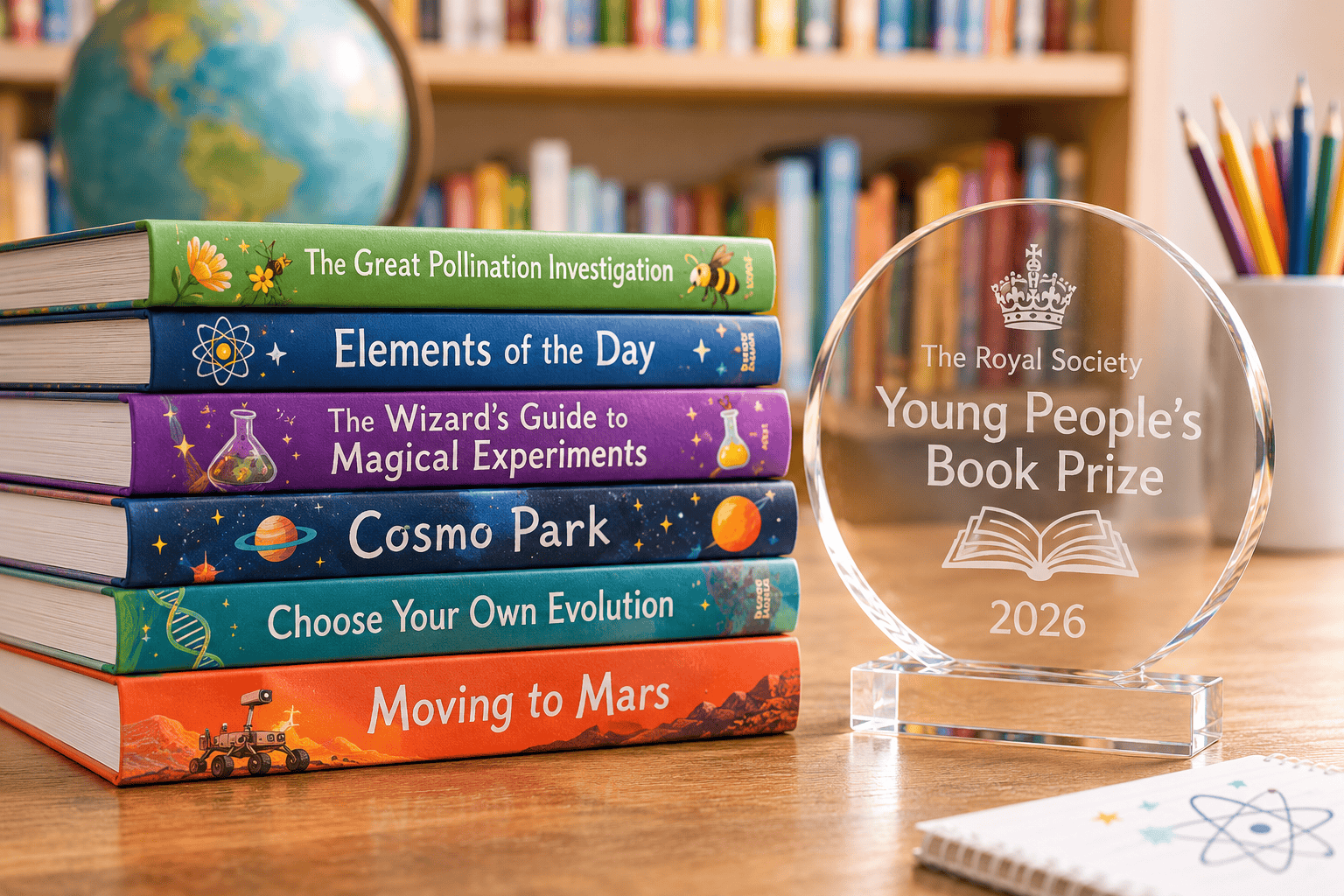
The Royal Society Young People’s Book Prize 2026 shortlist runs to six titles, and the adult panel that chose them will not be picking the winner. That is done by judging panels of young people at schools, science centres and community groups across the United Kingdom.
“Last year, votes were cast by over 11,000 young people, making up around 600 judging panels,” says Cristina Lazzeroni, the particle physicist who chairs this year’s judging panel.
The prize, as she explains in an interview with Tuva Kahrs, recognises “the best science writing for children under fourteen”, and its stated purpose is twofold: “The aim is to promote science literacy in young people, and to inspire them to read about science.”
A shortlist chosen by adults and a winner chosen by children is an unusual arrangement, and it shapes what the panel goes looking for.
“What we look for in the books is that they combine accurate science with originality,” Lazzeroni says — an unusual topic, a novel perspective, or an imaginative approach.
Four people sat on the shortlisting panel with her: Andrew Blair, a primary school teacher and science subject leader; Joshua Kestel, a Royal Society Newton International Fellow who studies the relation between plants and pollinators; Hiba Noor Khan, an award-winning children’s book author and former teacher of physics; and Ken Wilson-Max, also an award-winning children’s book author, and an illustrator and publisher.
Lazzeroni credits the mix of expertise with making the discussion workable. The books cover a wide range, from pollination to the periodic table to the colonisation of Mars.
*The Great Pollination Investigation* by Deborah Hocking is the title aimed at the youngest readers, with interactive elements and pages that unfold. “This is such a beautiful book, and the illustrations are magnificent,” Lazzeroni says. Asked whether there is an upper age limit, she is direct: “There is absolutely no upper age limit.” The book is fact-checked by the Royal Botanic Gardens at Kew.
*Elements of the Day* by Samantha Lewis, illustrated by Hao Hao, connects everyday experience to the periodic table, which Lazzeroni says children often meet first in a quite abstract way. Her view is that the book “makes the periodic table tangible and approachable”, with enough humour and strangeness to hold attention, and that it can encourage even the most reluctant pupils to engage with the table outside of school. A companion volume, *Forces of the Day*, has just come out.
*The Wizard’s Guide to Magical Experiments* by A J Wood, illustrated by Jo Rioux, uses magic as the way in. “The collection of experiments is fantastic — I want to do them all!” Lazzeroni says. The panel’s reasoning is that a child might pick the book up for the magic and stay for the science, working through experiments at their own pace.
*Cosmo Park*, written by Madeleine Finlay and illustrated by Tom Dearie, delivers cosmology and astrophysics as a comic book — “a unique approach among the books that we looked at”, in Lazzeroni’s words. It follows a girl called Kara and her cat through the hot topics of astrophysics, and she argues that “the story is not just a way to convey information; it holds up on its own.” Finlay has been shortlisted for this prize before, with *Beetles for Breakfast*.
*Choose Your Own Evolution* by Jules Howard, illustrated by Gordy Wright, is built as a choose-your-own-adventure through the history of evolution. “You can become extinct quite rapidly, but you can also survive for millennia; it’s highly interactive,” Lazzeroni says, adding: “I must admit, I became extinct a few times, then went back and started again.” The final two pages show the tree of evolution so readers can trace the paths they did not take.
*Moving to Mars: Building a Colony on the Red Planet* by Eduard Altarriba et al. closes the list. “I really, really like *Moving to Mars*,” Lazzeroni says. “At the end of the book the idea is more approachable than it was at the beginning, because you feel you’ve considered carefully and scientifically so many aspects.” She singles out its retro visual style and the way it can be read straight through or dipped into. The interview notes a follow-up, *Moving to the Moon*, due this month.
Asked whether any branches of science were thinly covered by this year’s submissions, Lazzeroni names several: “For example, my particle physics, but also computer science, quantum mechanics, and condensed matter. It would be good to find a way to encourage more accessible books in these areas.”
Her own public work runs in that direction. She has taken part in interactive events across England, produced resources for schools, and says she is especially proud of a project called Particle Physics for Primary Schools. She has also been an expert consultant on the *Britannica All New Children’s Encyclopedia*.
What she valued in the shortlisted books, she says, is that they do not talk down to their audience: the variety of titles, the fact that they can be understood at different levels, and that “the authors and illustrators haven’t underestimated their young audiences. The books here are for everybody.”
The winner will be decided by the children’s judging panels. Lazzeroni will not envy them the task. “I’m glad not to have to choose the best from the six books shortlisted, because I’d find this extremely difficult.”
For more insights into this year’s children’s book selections, read about the 10 Best Illustrated Children’s Books of 2026 named by the NYT and NYPL.
+ show Comments
- Hide Comments
add a comment